
Behind the Buzz: What Vienna's Bee Hotels are Revealing About Urban Wild Bees

By Theresa Ranieri
PhD Candidate | Konrad Lorez Research Center
Vienna offers extremely favourable living conditions for wild bees, thanks to its unique geographical location and mild urban climate. As a result, approximately 490 bee species are recorded for Vienna which account for ~70 percent of Austria’s known wild bee species. Wild bees can find suitable habitats in the large green spaces on the outskirts of the city as well as within the city itself. Dry meadows, parks, gardens and fallow land provide both food and opportunities to build their nests (Zettel et al., 2015, 2022). Since cities are expanding, there is still much to explore about how wild bees live and thrive in urban environments (i.e. Liang et al., 2023).
So, what can we learn about wild bees in urban areas, if over 200 people living in different districts all over Vienna take a closer look at wild bees right on their doorstep? UrbanBEE, a Citizen Science project, was funded to find the answer to this question, using bee hotels as nesting aids. They provide an opportunity to observe certain cavity-nesting solitary bee species up close. Furthermore, artificial nesting aids are easy to obtain and can be set up in many habitats. They can therefore serve as a tool to help, for example, study the behaviour of different bee species or to identify changes in bee diversity within certain environmental parameters more quickly (MacIvor et al., 2017).
By collecting observations from many different locations, we aim to gain insight into the use of bee hotels across the city and document the diversity of their inhabitants. That is why we handed out over 243 bee hotels in Vienna to Citizen Scientists. This allowed them a fascinating insight into the world of wild bees. Participants photographed their bee hotel once a week and shared their observations with us, creating a large data set with the help of Citizen Science.
After 24 weeks of data collection from very dedicated Citizen Scientists, we collected 3439 answers to our questionnaires and 3919 pictures. As expected, the number of responses varied throughout the monitoring period due to vacation, school break and shifts in motivation; but overall, the participation was very high. Although there is a slight decline towards the end, still almost half of the Citizen Scientists continued to submit a picture in the final week of observation.

All collected data is now being evaluated to identify patterns about wild bee activity at bee hotels throughout Vienna. The following section states some of our first findings from the collected data this year.
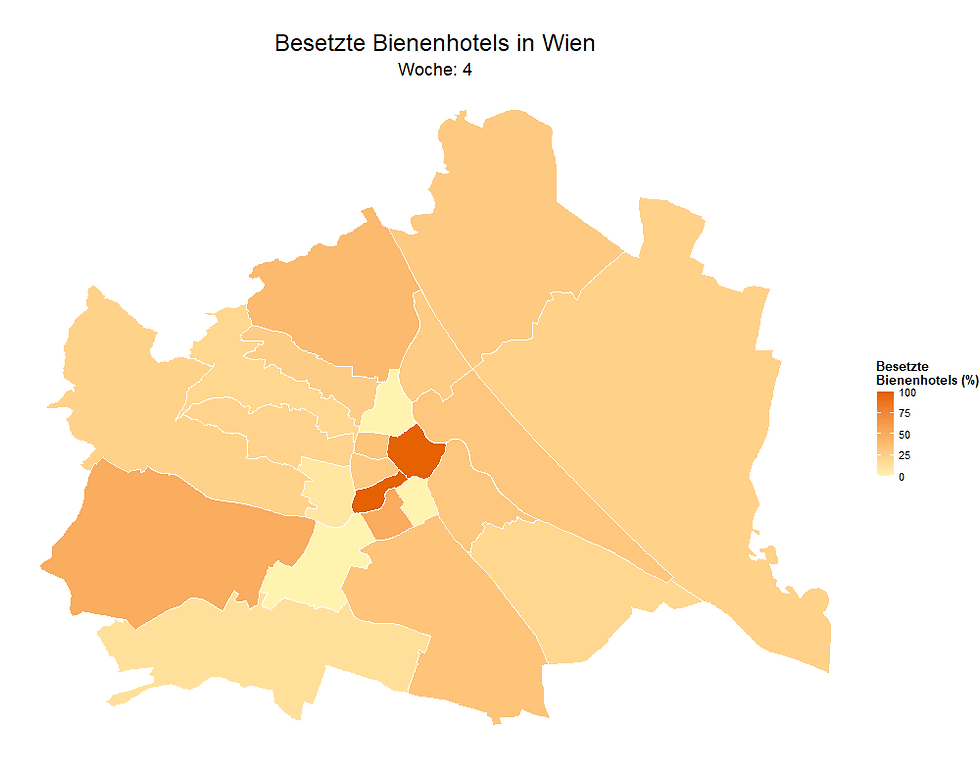
The bee hotels were placed across all 23 districts of Vienna although they were not evenly distributed between them. Some districts like the 22nd were represented more strongly while we only had one participant in the 6th district. Despite these variations, the project collected data from a wide range of urban locations. Overall occupancy was very high, the only exception being the 15th district where more than half of the bee hotels stayed empty during the whole project (Chart 2). Only 32 bee hotels were empty at the end of summer, representing 12,8%. The chance of occupation was very high in the first weeks of spring, which coincides with the active period of common species such as Osmia bicornis or Osmia cornuta.
Nevertheless, there were some later nesting bee species resulting in new occupations towards the end of data collection (Chart 3, 5). Bee hotels in the inner districts seemed to show lower occupancy rates than in the outer districts across the map of Vienna (Chart 4).



There is still a lot to learn from the data as we have just started with our data analysis. For example, we want to find out if bees use landmarks on the bee hotels to help them orientate. Beyond that, we will take a closer look at the occupancy by evaluating the number of filled holes per bee hotel. When the data analysis is completed, we also look forward to sharing and comparing our results with our international partners in Europe and South Africa.
REFERENCES
Liang H, He YD, Theodorou P and Yang CF (2023). The effects of urbanization on pollinators and pollination: A meta-analysis. Ecology Letters 26 (9), S. 1629–1642.
MacIvor, J. S. (2017). Cavity-nest boxes for solitary bees: a century of design and research. Apidologie, 311-327.
Zettel, O. S. (2015). Kommentierte Liste der aus Wien (Österreich) nachgewiesenen Bienenarten (Hymenoptera: Apidae). Zeitschrift der Arbeitsgemeinschaft Österreichischer Entomologen, 67: 137–194.
Zettel, O. S. (2022). Kommentierte Liste der aus Wien (Österreich) nachgewiesenen Bienenarten (Hymenoptera: Apidae), 2. Fassung. Zeitschrift der Arbeitsgemeinschaft Österreichischer Entomologen, 74:71–126.


Comments